We Are The Champions!
Every pet may not be a show dog, but be assured, every show dog is a pet – Pat Trotter
Showing Your Bedlington
Let the Adventure Begin!
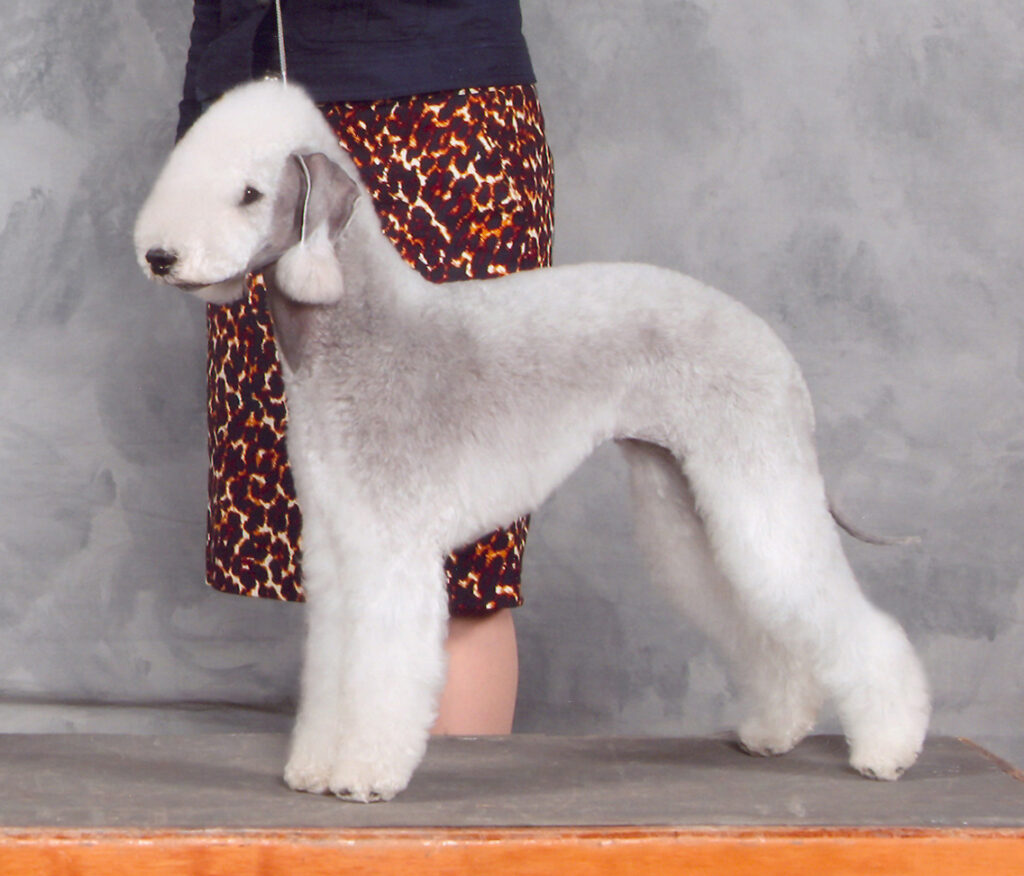
Your dog’s breeder is the best person to explain conformation showing and help you get started. Conformation is the term for shape, structure, and arrangement for each purebred dog. We refer each breed’s written standard for specific details on shape, structure, and arrangement. The Breed Standard is what separates one purebred dog from another.
It is a good idea to attend a dog show and conformation classes to learn, and help your dog to learn, what conformation showing requires. Check with nearby AKC dog clubs and private training facilities for shows and classes. Again, your breeder should be a great resource and willing to help you get started, even if they do not live in your area. If your breeder is unable to be your mentor, please contact the Bedlington Terrier Club of America for advice and assistance.
Take the Lead & Set the Pace
The first time you walk onto the grounds of an AKC dog show, it feels like stepping into a world that has its own rhythm and language. There are grooming tables everywhere, people moving with quiet purpose, dogs that seem to know exactly why they are there – and then there’s you, holding the lead of your Bedlington Terrier, hoping you look like you belong. You do, even if it doesn’t feel that way!
What you will quickly learn is that conformation showing isn’t about training tricks or obedience commands. It’s about structure, balance, and breed type. Your Bedlington isn’t competing to ‘win’ in the usual sense; it is being evaluated against a written description – the AKC Bedlington Terrier Breed Standard. Every detail matters because that standard represents what the breed was meant to be: elegant but strong, refined but capable, distinctive without exaggeration.
As you observe the ring, you see what makes a Bedlington a Bedlington. The Judge’s eyes linger on the topline, the clean head crowned with a coiffed topknot, the light and effortless movement around the ring. When it is your turn, you place your dog on the table and set up the legs. The Judge approaches calmly, checking the bite, hands moving over your dog’s body, shoulder, rib, legs, and tail. Your job is simple but not easy – stand quietly, keep your dog relaxed, and trust your preparation.
Correct movement is a language of its own. As you move your dog down and back, feeling the rhythm of its stride through the lead. Around the ring, move at just the right speed – not rushing or dragging so the Bedlington’s natural springy gait, reach and drive can be seen. When you stop, either free stack or place each foot carefully relying on your hands and eyes to present your dog to its best.
Grooming, you will soon discover, is where the breed reveals its honesty. A Bedlington’s outline can be made or ruined with scissors. Transitions must be smooth and in a series of curves. Even a beautiful dog can be overlooked if the trim is over exaggerated or careless. Many new exhibitors lean from mentors or professional groomers who know and understand the Bedlington groom. Every grooming session teaches you more about your dog’s structure than a textbook ever could.
The Dog Show Community
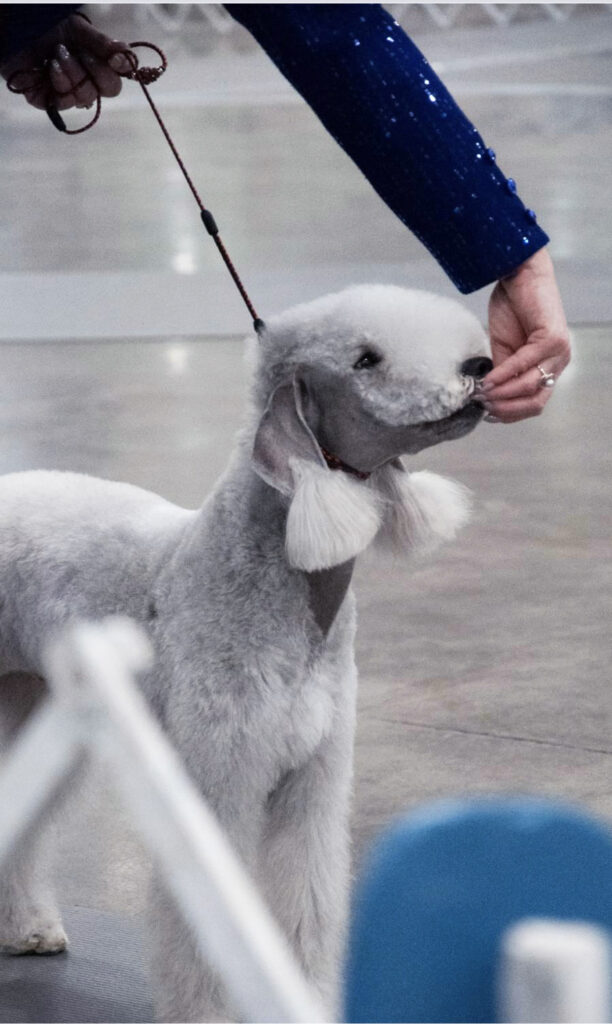
Between classes, you start to notice how much community exists in this sport. Experienced exhibitors offer quiet encouragement. Someone holds your dog while you run to the restroom. Another person gives you a last-minute tip before you enter the ring. You realize that everyone here remembers their first show and most are rooting for you more than you expect. As the day goes on, wins begin to matter less than progress. Maybe your dog held the stack longer. Maybe the movement clicked. Maybe you remembered to breathe. Each show builds confidence, not just in your dog, but in yourself. You learn to read judges, anticipate ring patterns, and present your Bedlington with calm assurance. By the time you pack up and head home, tired but proud, something has shifted. The show world no longer feels intimidating—it feels familiar. You understand now that showing a Bedlington Terrier is a partnership. It’s about presenting a living piece of breed history with care, respect, and pride. And once you’ve stepped into that ring, chances are you’ll be back, chasing not just ribbons, but the quiet satisfaction of doing it a little better each time.
Handling Basics
You don’t need to look flashy, you just need to look competent.
- Keep your lead light and unobtrusive
- Always be aware of the judge’s position
- Practice stacking calmly, nothing erratic
- Move at your dog’s natural speed
- Pro Tip: Bedlingtons should float, not race
You do not have to be perfect and neither does your dog. Judge’s appreciate a relaxed, happy dog, a handler who listens and adapts, sportsmanship and ring awareness.
Everyone Was Once New - Even the Pros!
Taking Your First Step
Attend a dog show without entering and watch ringside.
Find a Bedlington mentor or breeder willing to coach and mentor.
Take a handling class, many kennel clubs and some training facilities offer handling classes.
Start with smaller local shows before large Specialties.
If possible, attend a Bedlington Terrier Club of America Specialty. You will learn more in one weekend than months alone. Let us help you. The BTCA is here to support your efforts.
Showing a Bedlington Terrier is a learned craft. You and your dog are representing history, function, and artistry all at once. The learning curve is real – but so is the joy when your dog settles into the ring and owns it!
AKC Conformation Breakdown
AKC Conformation is about how closely your dog matches the AKC Breed Standard. For Bedlingtons, that means elegance with strength and a beautiful outline with athletic ability.
- Dogs are judged against the written standard, not against each other
- Structure, movement, temperament, and breed type matter
- The judge is asking ‘Is this dog a good representative of the breed?’
Conformation Classes
You don’t just walk in and compete against champions, thank goodness! Typical class progression:
- Puppy Class (6-9 months, 9-12 months, 12-18 months)
- Bred By Exhibitor Class
- American Bred Class
- Open Class
The winners of each class move on to compete for Winners Dog and Winners Bitch and earn points towards its Championship Title. Winners Dog and Winners Bitch will advance to Best of Winners.
Best of Breed is the class where Champions are entered and compete.
It's Show Time! A Play-By-Play & No Surprises
- Enter the ring and line up one dog behind each other
- Move once around the ring as a group or as the Judge instructs
- Place your dog on the table for your individual exam
- Judge checks bite, head, body, front, rear, tail, and coat
- Move down and back so the Judge can evaluate movement of the dog’s front and rear
- Stop and stack the dog to the Judge
- Move your dog around the ring so the Judge can evaluate side gait, reach and drive along with level top line
- Stack up your dog in line
Understanding
The Breed Standard
Before you enter a dog show, you must first understand the Breed Standard.
The Judge expects to see:
- Long, strong, narrow head with profuse top knot
- Almond-shaped eyes with keen expression
- Triangular, low set ear
- V-shaped front
- Distinctive slight arch over the loin
- Overall balance and symmetry with gentle curves
- Light, springy movement and never ground pounding steps
Ring presence and temperament is alert, confident, never shy or sharp. Judges will notice attitude.
If you don’t already have the Bedlington Terrier Breed Standard, get a printed copy and annotate it here:
Grooming: Where Bedlington Shows Are Won or Lost
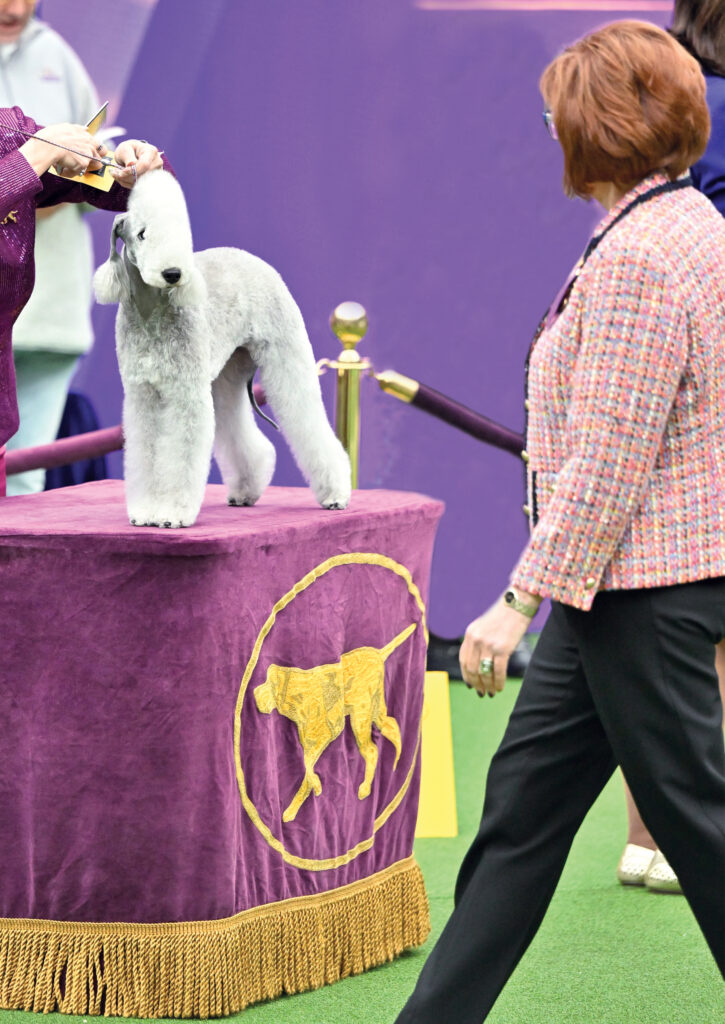
Trompe l’oeil – To Deceive The Eye. Let’s be honest – this breed is unforgiving when it comes to grooming. A great dog can be beaten by a poor or average grooming just as easily as a substandard dog can win with an exaggerated or fault hidden groom. Learn from a breeder or grooming mentor. Attend a Bedlington grooming seminar, or hire a professional groomer if needed.
You need to master the following in order to become competitive:
- Correct silhouette or outline
- Correct placement of topline
- Smooth transition without clipper lines
- Clean sculpted finish without clipper marks
- The appearance of an honest dog without overemphasis, amplification, or becoming a charicature