Bedlington Terrier Judging Procedure
Guidelines Based on the American Kennel Club Breed Standard
CLASS ORGANIZATION & INITIAL ASSESSMENT Judging typically begins with the dogs positioned around the perimeter of the ring. The judge conducts an initial walk down the line to obtain a first impression of each entry.
EVALUATION OF SIDE GATE The next phase involves observing the side gait of each Bedlington Terrier by directing the class to perform one or more left-handed circuits around the ring. According to the American Kennel Club breed standard, the Bedlington Terrier gait is characterized by a light, springy step at slower paces. Judges may request the class to slow down to accurately assess correct movement. The Bedlington should not have tremendous reach and drive like a sporting dog or short, stilted, hackney action. However, they should be able to cover ground with adequate forward reach and rear drive. Remember, Bedlingtons were bred to catch vermin and small game.
TABLE EXAMINATION Bedlington Terriers are examined on the table. The judge should approach from the side, as the distinctive show trim on the head often limits forward vision of the dog.
HEAD EXAMINATION Proper evaluation of head proportions is essential. These features can be obscured by grooming. The breed standard highlights the near absence of a stop. It is recommended to use the “thumb test” to confirm both head proportions and the lack of stop. Remember, the head is shorter in skull and longer in jaw. The slender head should be without cheekiness or snipiness. The thumb test could also be used to feel for adequate bone or fill under the eye. The examination should be conducted carefully to maintain the dog’s presentation.
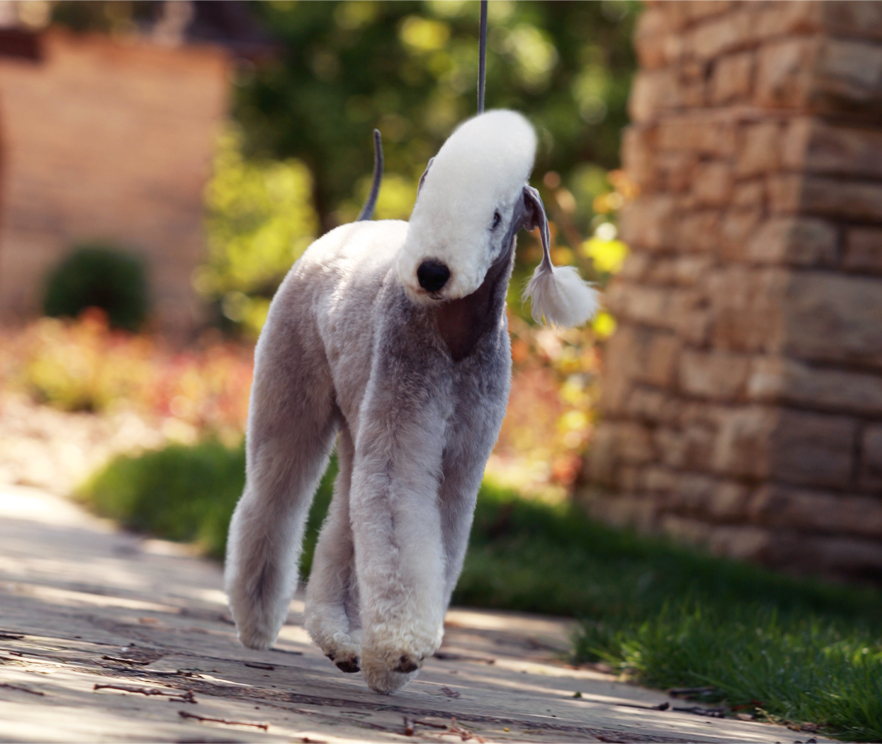
BITE & DENTITION The judge requests the handler to display the bite. The breed standard requires a full complement of teeth, with particular attention to the positioning of the lower canines. Lower canines clasp the outer surface of the upper gum just in front of the upper canines. Correct placement of the lower canines ensures the integrity of the underjaw. The Bedlington may have a level or scissors bite.
TOPLINE EVALUATION The topline evaluation of the Bedlington Terrier begins with the judge feeling for a long tapering neck into well laid-back shoulders. Feel for a moderate rise over the loin and a sloping croup. Due to advanced grooming techniques, accurate assessment of the topline requires tactile evaluation, running fingers through the coat along the neck, shoulders, back, loin, and croup. Remember grooming can hide many issues, you must feel to “see” the dog, let your hands be your eyes.
EXAMINING THE FRONT & CHEST Feel for the depth of the chest, ensuring the keel is deep and the forelegs are straight and correctly placed in a “V” shape. Bedlingtons are the only breed that have a V-shaped front, wider at the chest tapering closer together at the feet. Run hands down the front legs to assess elbows, the V front, and foot positioning. Next, pick up a foot, check the pads of the feet and note where the dog places it back when standing.
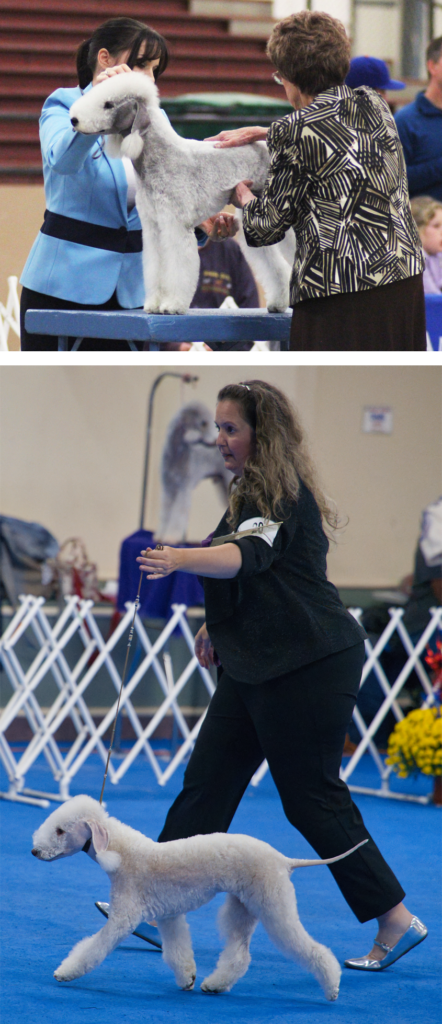
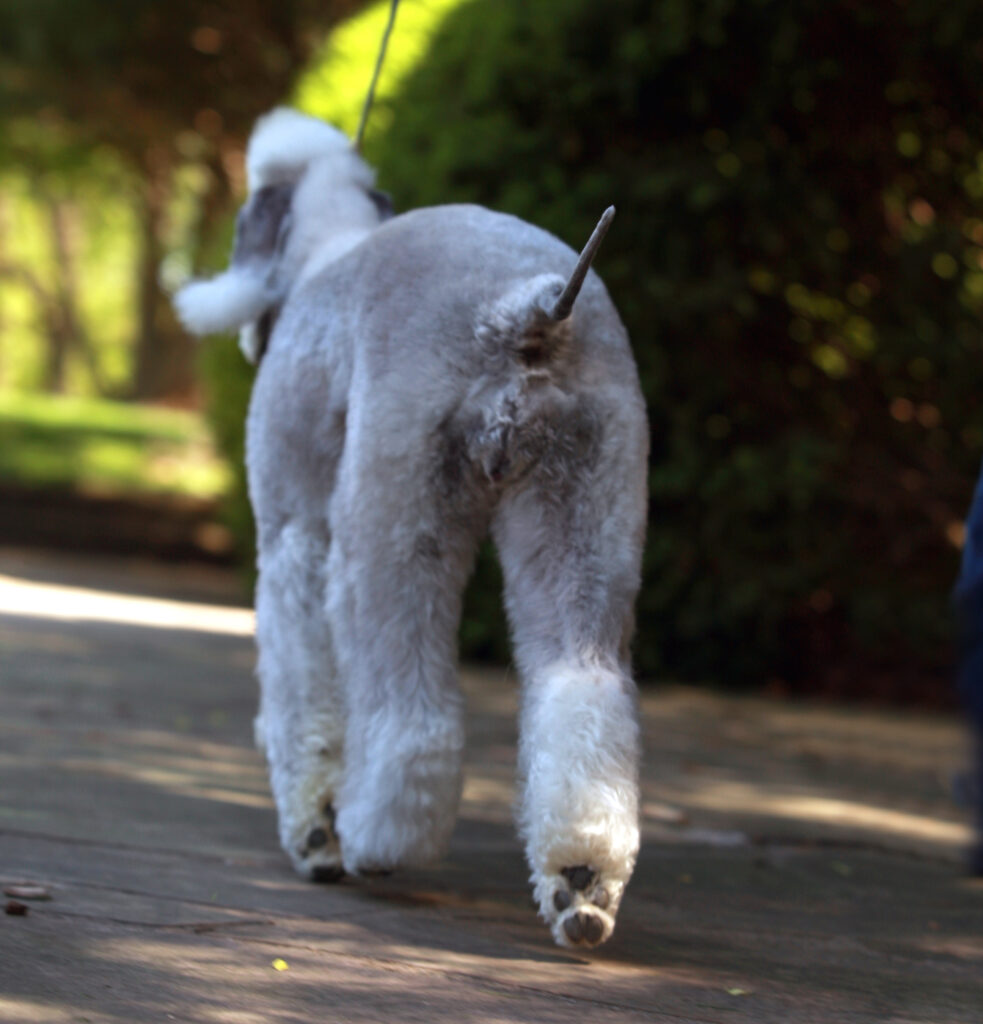
SIDES & REAR EVALUATION Bedlingtons should be flat-ribbed. To determine the end of the ribcage, the judge’s hand is typically run along the sternum and occasionally into the loin. Examine the scimitar-shaped tail which should fall off the croup and is low set. Also check for kinks along the tail vertebrae.
ASSESSMENT OF THE FOOT During the examination, lifting a front paw in the manner of a blacksmith is advised to confirm the hare foot shape of the Bedlington foot, as specified in the breed standard. Corny pads should be penalized. This is a standard inquiry during breed interviews for new judges. Bedlingtons are not flat footed and have a slight bend to their strong front pasterns.
COAT The breed standard specifies that the hair on the body should not exceed one inch in length with hair on the legs slightly longer. Some judges utilize a visual marker on their finger to ensure compliance with this requirement over the body. Coat texture should be a distinctive mixture of hard and soft hair standing up from the body. Crisp to the touch but not wiry.
COLOR Bedlingtons come in six colors, blue, sandy, liver, blue and tan, sandy and tan, liver and tan. In bi-colors, the tan markings are found on the legs, chest, under the tail, inside the hindquarters and over each eye. Easily distinguished as puppies but difficult to see in adults. The topknots of all adults should be lighter than the body color. Dark or black patches of hair are from an injury and are not objectionable. Darker body pigmentation of all colors is to be encouraged. Bedlingtons will vary in coat color all their lives, lighter to darker shades of all colors are acceptable.
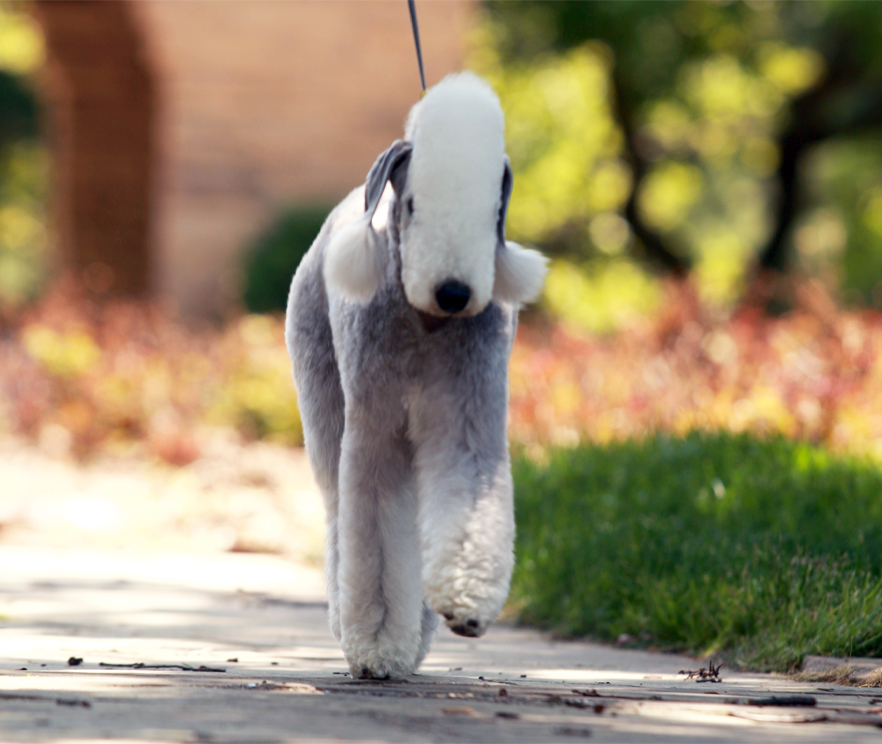
MOVEMENT AND TAIL CARRIAGE After the table examination, the judge instructs the handler to move the dog down and back. The Bedlington should move with a light, springy step, unique to the breed. Although they are noted for outstanding endurance and can gallop at great speed, the Bedlington is not to race around the ring. Look for correct tail carriage, low and not above the top line; a raised tail may not be faulted in spirited moments or when the dog is showing exuberance such as a happy puppy.
TIME & PROTOCOL Experienced judges are expected to evaluate up to 25 dogs per hour, while newer judges are scheduled for 20 dogs per hour, averaging approximately two and a half minutes per dog. The time spent on each dog may vary at the judge’s discretion. Once the table examination is complete, if additional information is required, the exhibitor may be asked to return the dog to the table but should not be reexamined on the ground.
Contemporary judging practices have moved away from the triangle and “L” patterns, focusing instead on observing the natural “V” front when the dog stops independently, rather than when positioned by the handler. Check also the position of the rear legs when the dog comes to an independent stop.